What is Evacuation Day?
Evacuation Day is approaching. That thought likely flickered like a pipe dream in George Washington’s mind during the winter of 1775-1776; he had dispatched Henry Knox to retrieve heavy artillery from Fort Ticonderoga in upstate New York, hoping that the 25-year-old Knox could miraculously transport 60 cannon (weighing 120,000 pounds) over 300 miles in the dead of winter to South Boston. If this Herculean effort could somehow, someway be manifested, it was Washington’s best shot at evicting the British from Boston, a town they had occupied for nearly 8 years.
Knox succeeded. Through snowy forests and mountain passes, with teams of oxen pulling the artillery across frozen rivers, lakes and landscapes, the remarkable journey culminated in March of 1776 when Knox’s Noble Train of Artillery reached Dorchester Heights in South Boston. When the British awoke that morning in March, they instantly understood their predicament; with 59 cannon now trained upon the naval fleet nestled in Boston Harbor, it was time to attack the Heights and take the cannon or abandon Boston altogether. Initial plans to charge the Heights were derailed by weather, that great X-factor that has influenced so many crucial moments in military history. In this case, a late winter Nor’easter swept across New England, creating inclement conditions that precluded any effort to take the cannon by force. That left one option. Evacuation. And on March 17, 1776, the British left Boston. They never returned.
The Knox Train and ensuing evacuation represent the culmination of key semiquincentennial moments that Boston has been commemorating for over a decade. As the rest of the nation gears for the 250th on July 4, for Boston it is essentially the tail end of a momentous arc that illustrates the singular and seminal role that Boston played in the forming of the United States. From the Stamp Act repeal through the occupation, from the Boston Massacre to the Boston Tea Party, and the myriad conflicts of 1775 – Lexington, Concord, Bunker Hill – it was the catalytic events in Boston that truly set the colonies on a path to war and, ultimately, independence.
Evacuation Day Events
There are three great opportunities for residents and visitors to take part in programming and reenactments related to the Knox Train coming through Cambridge and Roxbury en route to South Boston. Here are the highlights:
Saturday, February 28, 2026 – 2:00 pm: Cambridge, MA
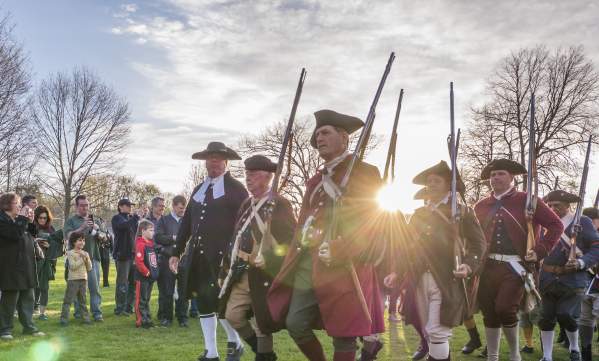
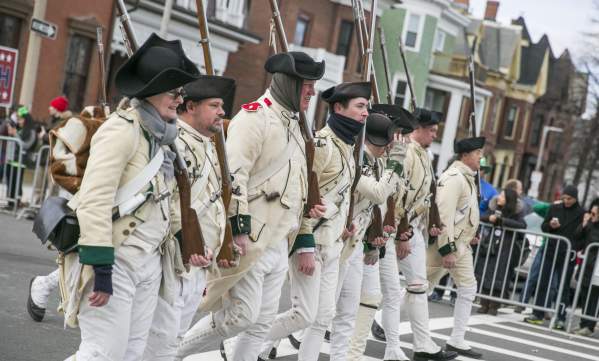
On Saturday, February 28 there will be an outdoor procession commencing at 1pm at Joan Lorentz Park. After the procession, an indoor commemoration takes place at the Cambridge Public Library at 2pm. Per our friends at Revolution250, the procession will include “horse-drawn sleds, 1776 militia units, artillery unit, and fifes and drums, before the indoor commemorative program recognizes Cambridge and the surrounding communities who aided Knox in 1776.” Elected officials, local dignitaries and historians will all be taking part in the events.
Saturday, March 7, 2026 – 2:00 pm: Roxbury, MA
On Saturday, March 7, City of Boston officials, including Mayor Wu, will gather in Roxbury to mark the 250th anniversary of the Knox “Noble Train of Artillery,” arriving in Boston. Events are free and open to the public and will feature a light show at First Church in Roxbury. A procession of 1776 militia units will start at Fenway High School and process through Roxbury before finishing at First Church where a speaking program will begin at 3pm.
Tuesday, March 17, 2026 – 9:00 am: South Boston, MA
The commemorative affairs culminate on March 17 in South Boston, officially marking the 250th anniversary of Evacuation Day with a memorial service in St. Augustine’s chapel followed by a short procession to Dorchester Heights. At the Heights, elected officials and community leaders will convene a program that will include reenactment units from “the Lexington Minute Men, the 2nd Massachusetts Regiment, the Henry Knox Color Guard, the Henry Knox Regiment of Artillery, General George Washington (portrayed by John Koopman) and historical assets from Fort Ticonderoga and Saratoga 250.”
The information above is provided by our friends at Revolution 250 and Conventures, who have also created a full overview of Evacuation Day activities.